Executive Summary
Buy the Current Model G if you need a full-size grill that plugs into a standard outdoor outlet, gives you two independently controlled heat zones, and avoids propane, charcoal, and open flame. Skip it if smoky flavor, mechanical simplicity, or the lowest possible grill price matters more than precise digital control.
The pitch is simple: real backyard-grill temperatures without storing fuel.
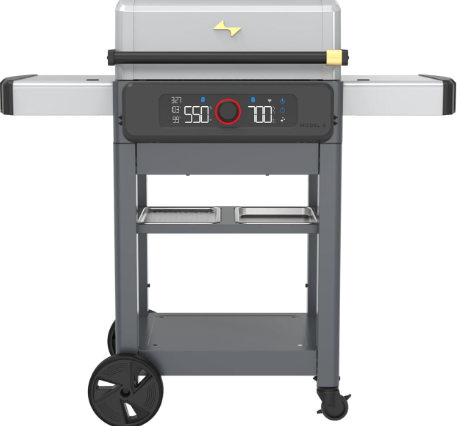
The Model G can reach 700°F, run two foods at different temperatures, track meat with included probes, and send app notifications. Early hands-on reviewers generally like the cooking experience and physical design. The harder question is whether its app, electrical dependence, cleaning routine, and premium price are a better fit than a dependable Weber gas grill or a smaller Weber Lumin electric model.
BEST FOR
This grill is best for condo, townhouse, apartment, and close-neighbor households that have a suitable outdoor outlet and want a cleaner, more predictable grilling workflow without handling propane or charcoal.
- + Buyers in communities that restrict open-flame grills
- + Weeknight cooks who value push-button heat and repeatability
- + Families cooking proteins and vegetables at different temperatures
- + Buyers who want app alerts but still expect full manual controls
Skip If
This is not the universal replacement for every gas, charcoal, or pellet grill.
- You want charcoal or wood smoke to be the central flavor of the food.
- Your patio lacks a properly placed outdoor GFCI outlet or you expect to move the grill far from power.
- You prefer a grill that can remain useful for decades without apps, electronic controls, probes, or replacement boards.
- You mainly cook for two and could meet your needs with a much smaller, less expensive electric grill.
Price Reality Check
The Model G generally occupies the premium end of the electric-grill category. Recent marketplace and editorial references have placed Current models around the upper hundreds of dollars, overlapping with capable Weber gas grills, pellet grills, and premium griddles.
At this price, convenience must be the feature you are actually buying.
The value case becomes stronger when propane storage is inconvenient, charcoal is prohibited, or precise dual-zone control makes outdoor cooking happen more often. It becomes weaker when you already have permission and space for a reliable gas grill that offers more conventional repair paths and a longer public ownership record.
Deep Dive
Dual-Zone Heat That Changes the Workflow
The most useful feature is not the app. It is the ability to run two independent temperatures across the cooking surface. That lets you sear meat on one side while vegetables, fish, or bread cook more gently on the other.
This is closer to having two outdoor ovens than one traditional burner box.
- Temperatures can be set independently for mixed meals.
- The grill reaches up to 700°F, which is meaningful for searing rather than merely warming food.
- Included temperature probes reduce guesswork for chicken, steaks, and roasts.
- Physical controls remain available, so basic cooking does not require the phone app.
Buyer takeaway: Dual-zone precision is the feature most likely to justify the premium. Buyers who normally cook everything at one temperature may not extract enough value from it.
Electric Convenience Without the Tiny-Grill Compromise
Many electric grills are portable tabletop units. The Current is positioned as a full backyard appliance with side tables, wheels, a substantial lid, digital controls, and enough surface area for family cooking.
- No propane refill runs or partially empty cylinders.
- No charcoal lighting, ash management, or fuel storage.
- Consistent target temperatures are easier to repeat.
- Flameless operation may fit locations where gas and charcoal are restricted, though buyers must verify local rules.
Buyer takeaway: The Model G is most compelling as a location solution, not merely a technology upgrade.
Real-World Ownership Check
Early hands-on coverage describes a polished grill, but ownership is not friction-free. One reviewer reported roughly 90 minutes of assembly and recommended two people for lifting the cooking unit onto the cart. The high-heat cleaning mode burns residue down, but removable grate sections still need hands-on scrubbing.
- Setup: Plan for a substantial assembly session and confirm the outlet location before delivery.
- Maintenance: The burn-off cycle helps, but it does not eliminate scraping, sink cleaning, grease management, or weather protection.
- App: Alerts and recipes are useful extras, but early reviewers found recipe guidance incomplete and dual-recipe navigation awkward.
- Fit: The grill needs outdoor-rated power, enough patio clearance, and a location where the cord will not become a trip hazard.
- Deal breaker: A power outage or failed electronic control system stops the cook completely; there is no alternate fuel fallback.
What I Would Compare Next
Do not compare the Current only with other electric grills. Compare it with the best alternative way to solve your actual space and fuel problem.
- Weber Lumin: A smaller, established electric option for buyers who value portability and simpler ownership over dual-zone capacity.
- Weber Spirit EX-325: A strong gas-grill benchmark with smart monitoring, mainstream service familiarity, and traditional flame cooking.
- Ninja FlexFlame: A more versatile propane-and-electric outdoor system for buyers who also want smoking and accessory-driven cooking modes.
- Current G2: Check the newest Current generation and current bundle pricing before buying an earlier Model G configuration.
Buyer Signal Analysis
The Current grill is showing up in timely summer coverage because it solves a real problem: many buyers want serious outdoor cooking but cannot or do not want to manage open flame. The review gap is that most mainstream grill guides still organize the category around gas, charcoal, pellet, and familiar Weber-style electric models. Current receives positive individual reviews, yet there is still less long-term owner evidence about electronic durability, app support, replacement parts, and weather aging than there is for established grill brands.
Assimilated Signal Sources
- ManufacturerCurrent positions the grill around high heat, digital precision, standard-outlet convenience, probes, and connected guidance.
- Professional reviewsLifewire praised the controls, finish, dual-zone cooking, and 700°F ceiling while flagging assembly, app limitations, and manual cleanup.
- Recent editorial signalBon Appétit highlighted the newer Current G2 as a practical answer for a tight urban outdoor space with close neighbors.
- YouTube demosVideo demonstrations are most useful for judging size, startup speed, interface readability, grate layout, and the reality of cleanup.
- Amazon ownersLive marketplace feedback should be checked for shipping damage, assembly consistency, electronic failures, and support response before purchase.
- Reddit chatterDiscussion tends to center on apartment rules, electric-versus-gas flavor, outlet requirements, and whether premium electronics belong in a weather-exposed grill.
Unanswered Buyer Questions
QuietTrends read: The available evidence supports the cooking concept more strongly than the long-term ownership story. Buy for a specific electric-grilling need, not simply because the digital interface looks modern.
OUR VERDICT
COMPARE FIRST
Current Model G Dual-Zone Electric Grill
A convincing premium electric grill for flame-restricted or fuel-averse households, with enough unresolved long-term electronics and value questions to make comparison essential.
Final Buyer Guidance: Buy it when standard-outlet operation, 700°F heat, and two independent zones solve a real space or fuel problem. Compare the Current G2, Weber Lumin, Weber Spirit EX-325, and Ninja FlexFlame before paying full price.