Executive Summary
Buy the Denon Home 600 if your priority is room-filling music from one beautifully finished box, you value deep bass and Dolby Atmos playback, and you either already use HEOS or are comfortable building around it. Skip it if you mainly want voice-assistant convenience, TV connectivity, easy portability, or the safest value at $799.
The sound is the easy part. The ecosystem is the decision.
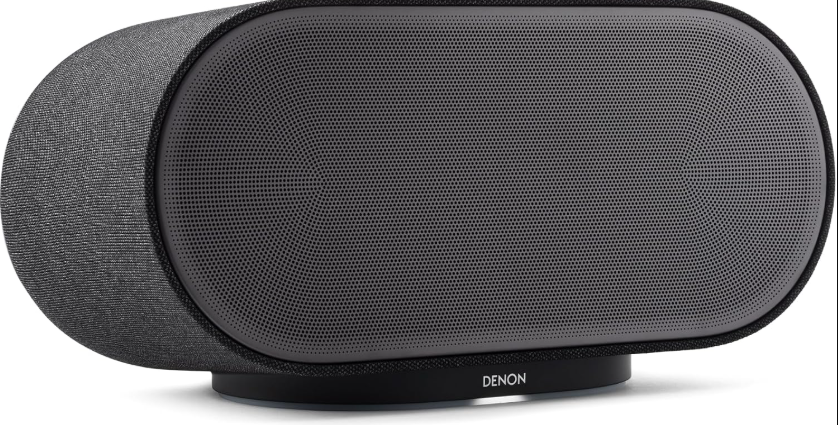
The Home 600 has the hardware to replace a compact stereo for many listeners: eight amplified drivers, two large built-in woofers, upward-firing speakers, high-resolution streaming, AirPlay 2, Bluetooth, aux input, and USB-C playback. The buyer question is whether that elegant simplicity is worth paying more than a Sonos Era 300, a pair of smaller speakers, or an actual soundbar-and-subwoofer setup.
BEST FOR
The best buyer wants serious music performance without separate amplifiers, speaker wire, a subwoofer, or two boxes occupying the room. It makes particular sense for an existing Denon or Marantz household where HEOS multiroom playback is already part of the plan.
- + Music-first listeners who want one premium speaker instead of a traditional stereo stack
- + Denon or Marantz owners expanding an existing HEOS multiroom system
- + Buyers who want strong built-in bass without adding a separate subwoofer
- + Larger rooms with a permanent surface deep enough for an 18-inch-wide, nearly 10-inch-deep speaker
Skip If
The Home 600 is marketed as a wireless smart speaker, but that label can imply conveniences it does not deliver by itself. The wrong buyer may pay $799 expecting a giant HomePod or a television-ready Dolby Atmos soundbar and discover that it is really a premium network music system.
- You expect native Alexa, Google Assistant, or independent Siri operation.
- You need HDMI eARC for simple television audio and full movie-format handling.
- You want a speaker that can move easily between rooms or run on battery power.
- You dislike controlling expensive hardware through an app with mixed usability feedback.
- You can accommodate two conventional powered speakers and care more about true stereo separation.
Price Reality Check
At $799, the Denon Home 600 sits above mainstream smart speakers and well into compact-system money. A Sonos Era 300 lists for substantially less, while two HomePods, powered bookshelf speakers, or an entry-level amplifier-and-speaker package can create a wider physical stereo image.
At this price, “one box” has to be a benefit—not merely a limitation.
The value is strongest when the Home 600 replaces several purchases: stereo speakers, amplification, a music streamer, and perhaps a small subwoofer. It is weaker when you are starting from scratch and simply want good sound, because the market offers many cheaper paths. Also budget for the possibility that one Home 600 becomes two; stereo pairing and HEOS expansion are attractive, but they quickly turn an $799 decision into a much larger system investment.
Deep Dive
Eight Drivers, Built-In Bass, and Dolby Atmos
Denon's driver count matters because the Home 600 is trying to create scale, bass, stereo width, and height from one enclosure. Its array includes dedicated tweeters, midrange drivers, upward-firing drivers, and two 6.5-inch woofers, each supported by its own Class-D amplification.
The buyer benefit: it sounds like a system, not a countertop accessory.
- The large woofers reduce the need for a separate subwoofer in normal music listening.
- Upward-firing drivers can add height and space to compatible Dolby Atmos Music.
- The wide cabinet creates more scale than a typical cylindrical smart speaker.
- One enclosure still cannot place left and right channels as far apart as two physical speakers.
Buyer takeaway: Choose it for powerful, cohesive all-in-one sound. Choose separate speakers if soundstage width and placement flexibility matter more than simplicity.
Connectivity Is Better Than the “Smart Speaker” Label Suggests
The Home 600 supports Wi-Fi, Bluetooth, AirPlay 2, Spotify Connect, compatible high-resolution services through HEOS, a 3.5mm analog input, and USB-C playback from storage. This makes it more flexible with music sources than many lifestyle speakers.
The catch: flexibility is not the same as universal simplicity. Dolby Atmos Music depends on compatible services and playback routes, AirPlay remains stereo, and the USB-C port is not a simple computer or phone DAC input.
Buyer takeaway: Check how you actually listen—Spotify, Apple Music, Qobuz, local files, turntable, or TV—before assuming every path offers the same features.
HEOS Is Both the Advantage and the Risk
HEOS ties the speaker to Denon and Marantz receivers, soundbars, and speakers. That is a genuine advantage for an existing household because one app can group rooms and distribute sources across the system.
- Professional and owner feedback agrees that setup can be straightforward.
- Feedback is less consistent on navigation, service integration, reconnecting, and finding settings.
- The app can improve through updates, but it also means the ownership experience is partly outside the speaker hardware.
Buyer takeaway: Existing HEOS owners have a clearer reason to buy. New buyers should try the app and investigate their preferred streaming service before committing.
Real-World Ownership Check
This is not a small smart speaker. The Home 600 is approximately 17.7 inches wide, 9.9 inches deep, 8.9 inches tall, and about 17.6 pounds. It needs a permanent, stable location with breathing room, access to power, and enough distance from walls for sensible room tuning.
- Setup: Plan on HEOS account setup, Wi-Fi connection, streaming-service logins, room-position selection, and possible Apple Home settings if using Siri or AirPlay.
- Placement: Measure furniture depth. Reviews note that it can overwhelm mantels, shelves, and small apartments.
- Maintenance: Hardware care is simple, but software updates, network stability, and account access are part of ownership.
- Expansion: A second Home speaker, HEOS subwoofer, or Denon soundbar can extend the system, but expansion costs rise quickly.
- Deal breaker: There is no HDMI input, so it is not a direct substitute for a conventional TV soundbar.
What I Would Compare Next
The Home 600 should be compared against several different buying routes because its biggest strength—doing many jobs in one cabinet—is also what makes its value difficult to judge.
- Sonos Era 300: Compare ecosystem maturity, spatial audio, app experience, room fit, and the lower entry price.
- Denon Home 400: Compare if you want Denon's ecosystem and Dolby Atmos but do not need the 600's bass output or physical scale.
- Apple HomePod pair: Compare if Apple integration, Siri, and physical stereo separation matter more than broad wired connectivity.
- Premium powered bookshelf speakers: Compare KEF, Klipsch, Audioengine, or similar systems if true stereo imaging and television inputs matter.
- Soundbar and subwoofer: Compare if television and movies are at least as important as music.
Buyer Signal Analysis
The Home 600 deserves a closer buyer look because it falls between categories that are normally reviewed separately. Smart-speaker comparisons can understate its audio ambitions. Traditional hi-fi reviews may understate its convenience. Soundbar comparisons can mislead buyers because it lacks HDMI. The most useful review therefore starts with the room and listening workflow rather than the driver list.
Buyer Confidence by Evidence Type
Assimilated Signal Sources
- ManufacturerDenon specifies eight amplified drivers, Dolby Atmos Music, built-in dual subwoofers, Wi-Fi 6E, AirPlay 2, Bluetooth, aux, USB-C, HEOS, stereo pairing, and surround expansion.
- Professional reviewsRecent testing agrees on excellent sound, premium build, strong bass, and expansive presentation; recurring cautions are price, cabinet size, absent HDMI, limited native voice assistance, and HEOS friction.
- YouTube demosVideo coverage is most helpful for understanding the speaker's unexpected physical scale, touch controls, HEOS setup, bass output, and how it compares visually with Sonos and conventional speakers.
- Retailer ownersEarly Best Buy feedback praises sound and setup while repeatedly mentioning the large footprint and mixed HEOS usability. Some reviews were collected through retailer sampling programs, so long-term independent ownership remains thin.
- Community chatterDirect Home 600 discussion is still limited; the broader Denon community debate centers on HEOS reliability, multiroom integration, streaming-service support, and whether Sonos offers an easier ecosystem.
Unanswered Buyer Questions
QuietTrends read: Buyer confidence is high on sound and hardware, moderate on value, and lower on software fit. This is a strong product for a clearly defined listener—not a universal smart-speaker recommendation.
OUR VERDICT
Compare First
Denon Home 600
The Home 600 delivers premium, room-filling sound and unusually complete all-in-one hardware, but its $799 price, large footprint, absent HDMI, and HEOS dependence make the buying decision more personal than the strong audio performance suggests.
Final Buyer Guidance: Buy it if you want a music-first one-box system and HEOS fits your home. Compare it with the Home 400 and Sonos Era 300 if value and software matter. Choose powered stereo speakers or a soundbar if channel separation or television connectivity is the real priority.