Executive Summary
Buy the Dreo 740S if you cannot install a window air conditioner and want one of the more efficient, refined portable options for a bedroom, office, rental, or awkward room. Skip it if a window unit is feasible, because a good inverter window AC can cost less, occupy less floor space, and deliver equal or better efficiency.
The cooling works. The room-layout compromise is the real decision.
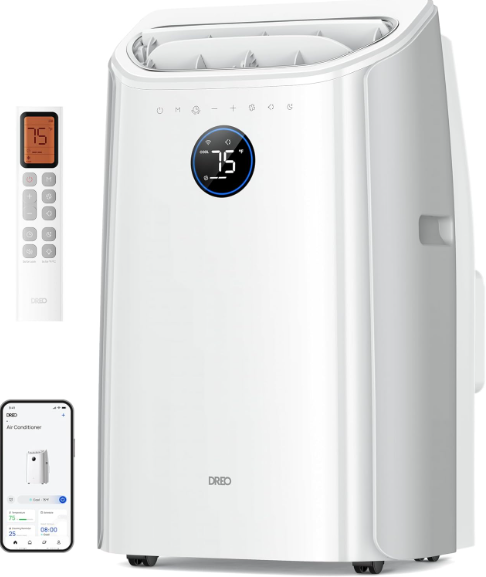
The 740S combines a dual-hose layout, adaptive inverter compressor, 10,000-BTU DOE cooling capacity, app control, and a self-evaporating drainage system. Independent testing found strong cooling and reasonable energy use, but also confirmed that the two hoses can push the machine roughly two feet into a room when the window sits well above the floor.
BEST FOR
The ideal buyer needs serious cooling in a room where a heavy window unit, mini-split, or permanent HVAC work is not realistic.
- + Renters who need reversible installation
- + Bedrooms and offices where lower sustained noise matters
- + Buyers with vertical or horizontal windows between roughly 20 and 53 inches
- + Homes where casters and room-to-room movement are more useful than compactness
Skip If
The 740S is not a universal upgrade over a window unit. It is a premium answer to installation constraints.
- You can safely install a Midea U-shaped or LG Dual Inverter window AC.
- You have limited floor space or cannot tolerate two visible six-inch hoses.
- Your room is materially larger than the claimed 400-square-foot coverage area.
- You need Matter support or a fully local smart-home workflow.
- You expect truly silent operation at maximum cooling power.
Price Reality Check
At about $699.99 before discounts, the Dreo 740S is one of the more expensive portable air conditioners in its class. Dreo sells more powerful fixed-speed models for less, while efficient window units commonly land around $400 to $550.
You are paying for portability, inverter control, dual-hose efficiency, and less hands-on drainage—not raw BTU value.
The premium becomes easier to justify when the alternative is lifting a 60-pound window unit twice a year, modifying a rental, or leaving an important room under-cooled. It becomes difficult to justify when a window AC fits safely and neatly.
Deep Dive
Dual hoses and inverter control improve the portable-AC formula
Single-hose portable air conditioners pull conditioned indoor air into the machine and can create negative pressure that draws warm air back into the room. The 740S uses separate intake and exhaust paths, while its inverter compressor adjusts output instead of repeatedly cycling at full power.
The practical benefit is steadier cooling with less wasted energy.
- Dreo rates the unit at 10,000 BTU DOE for rooms up to 400 square feet.
- The listed CEER is around 12, unusually high for a portable design.
- Tom's Guide recorded 3.54 kWh over seven and a half hours during hot-weather testing.
- The compressor can ramp down after reaching temperature instead of repeatedly switching fully on and off.
Buyer takeaway: The 740S is compelling when you specifically need a portable unit and care about operating efficiency over multiple summers.
Smart control is useful, but not the reason to buy
The Dreo app provides temperature adjustment, schedules, mode changes, and energy information. Alexa and Google voice control are supported, and the remote stores on a magnetic pad on top of the unit.
- Remote scheduling helps pre-cool a bedroom or office.
- Energy monitoring makes the cost of a heat wave less abstract.
- Physical controls and a remote remain available when the app is unnecessary.
Buyer takeaway: Treat connectivity as a convenience layer. Cooling performance, hose placement, and room fit matter far more.
Real-World Ownership Check
This is where the 740S changes from an attractive product photo into a piece of room infrastructure. The unit rolls easily, but every operating location still needs a compatible window, power outlet, hose route, and enough clearance for airflow.
- Setup: Assemble the window insert, connect two accordion hoses, seal gaps, and keep the hoses as short and straight as practical.
- Drainage: The self-evaporating system should handle normal condensation, but humid climates may still require the included drain hose.
- Noise: Dreo advertises operation as low as 42 dB; Tom's Guide measured about 54 dB from ten feet at full power before the inverter ramped down.
- Fit: A high window can force the hoses upward and make the unit project significantly farther into the room.
- Maintenance: Clean the filters, inspect seals, prevent hose kinks, and drain remaining water before seasonal storage.
- Deal breaker: Two large hoses and a $700 price are difficult to defend when a window unit is practical.
What I Would Compare Next
Compare cooling systems, not just portable AC spec sheets.
- Midea Duo: Another inverter dual-hose portable design, often at a lower price and with a mature review base.
- LG Dual Inverter window AC: Better when a conventional window installation is safe and floor space matters.
- Midea U-shaped window AC: A quieter, efficient route that preserves more window usability.
- Dreo 515S or 516S: Compare these when lower purchase price and higher nominal capacity matter more than inverter efficiency.
- Mini-split installation: The expensive but more permanent answer for homeowners cooling the same room every year.
Buyer Signal Analysis
The Dreo 740S arrived in spring 2026 and gained timely visibility during a hot summer and Prime Day cooling promotions. Search results contain a few useful hands-on reviews, but far less long-term evidence than buyers can find for established Midea and LG models. The central buyer questions—real efficiency, hose footprint, drainage, sleep noise, and window compatibility—are scattered across professional tests, retailer feedback, videos, and broader Dreo owner discussions.
Assimilated Signal Sources
- Manufacturer Dreo lists a $699.99 price, 10,000-BTU DOE capacity, 400-square-foot coverage, dual-hose inverter design, 42-dB minimum noise claim, app control, and self-evaporating drainage.
- Professional reviews Tom's Guide found strong cooling, good mobility, and high efficiency, while flagging price, hose appearance, floor-space use, and lack of Matter support. WIRED also highlighted quick cooling and easy movement during June 2026 testing and deal coverage.
- YouTube demonstrations Videos are especially useful for judging compressor sound, hose assembly, window-kit fit, airflow, and how much physical room the machine occupies.
- Amazon and retailer owners Exact-model feedback is still developing. Retailer syndication shows positive early ratings, while broader Dreo portable-AC listings have hundreds of reviews that support app usability and cooling but also surface breaker, sealing, and airflow complaints that buyers should investigate.
- Reddit discussions Portable-AC buyers repeatedly debate single versus dual hose, SACC versus ASHRAE ratings, negative pressure, drainage in humid climates, and whether a window unit is the smarter purchase.
Unanswered Buyer Questions
QuietTrends read: Confidence is high that the 740S cools effectively and improves on ordinary portable-AC efficiency. The remaining risk is ownership fit: buyers need to measure the window, visualize the hose path, compare electricity use, and decide whether portability is worth sacrificing money and floor space.
OUR VERDICT
Compare First
The Dreo 740S is one of the more convincing premium portable air conditioners, but it should be purchased because a portable design solves an installation problem—not because it automatically beats a window unit. Buy it for efficient, movable cooling in a rental, awkward room, or window-unit-restricted home. Compare Midea Duo and inverter window models before paying full price.
Editorial Disclosure
QuietTrends has not independently tested products unless clearly stated. Our analysis is based on manufacturer specifications, public buyer feedback, retailer information, warranty terms, available third-party reviews, and comparison research. We may earn a commission if you buy through some links, but our goal is to explain what is known, what is uncertain, and what buyers should compare before purchasing.