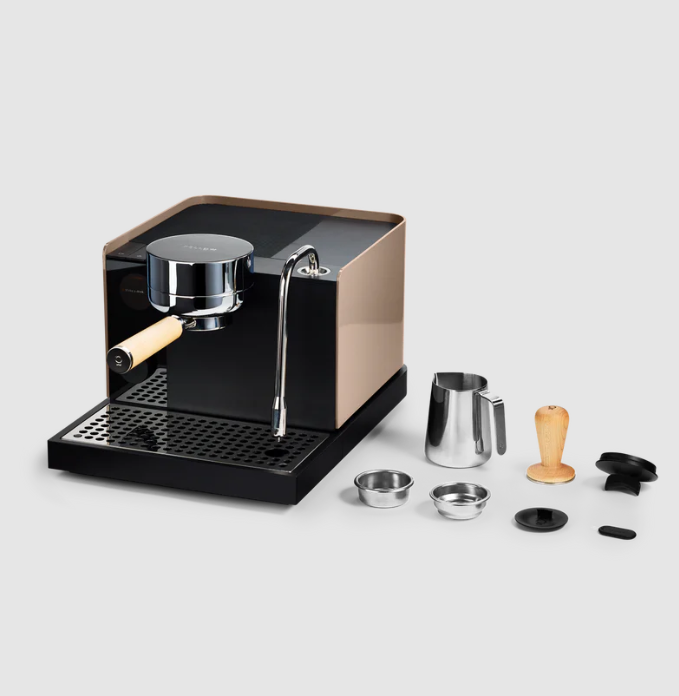
Executive Summary
Buy the Fellow Espresso Series 1 if you want serious espresso control without committing to the traditional ritual, heat-up time, and guesswork of a classic prosumer machine. Compare first if long-term serviceability, fully manual workflow, or proven multi-year reliability matters more than software-guided convenience.
The pitch is simple: expert-level adjustment without requiring expert-level patience.
Early reviews are unusually positive about shot quality, temperature stability, fast startup, and milk steaming. The remaining uncertainty is ownership over time: firmware maturity, repair paths, parts availability, and whether a touchscreen-first espresso machine will age as gracefully as simpler metal-and-boiler competitors.
BEST FOR
The ideal buyer wants café-quality espresso and real control, but does not want to spend every morning temperature surfing, timing flushes, or learning an opaque control panel.
- + Enthusiasts upgrading from Breville, De'Longhi, or entry-level single-boiler machines
- + Couples or households where one person wants guidance and another wants deep customization
- + Milk-drink buyers who care about powerful steaming and plant-milk texture
- + Design-conscious kitchens where countertop appearance matters
Skip If
The Series 1 is not the safest choice for every espresso buyer, especially at this price.
- You want a machine with decades of repair knowledge, widely stocked internal parts, and minimal software dependence.
- You prefer tactile knobs, gauges, and a completely manual workflow.
- You still need to buy a capable grinder and are already stretching to reach the machine's price.
- You mainly drink pods, drip coffee, or occasional milk drinks and do not need this level of control.
Price Reality Check
At roughly $1,499, the Series 1 sits above mainstream appliance machines and below many traditional dual-boiler and pressure-profiling systems. A recent Amazon promotion brought it to about $1,300, but that is still a serious purchase before adding a grinder, scale, water treatment, and accessories.
At this price, convenience has to improve the espresso—not merely automate it.
The value case is strongest when it replaces the urge to upgrade through several cheaper machines. It is weaker if you already own a dependable prosumer setup and enjoy the manual process.
Deep Dive
Guided Brewing With Real Adjustment
The Series 1 tries to bridge two worlds. Its screen can guide a newer user through brewing, while advanced controls expose pre-infusion, pressure, flow, temperature, and shot behavior for experienced users.
You can grow into the machine instead of outgrowing it.
- The bright interface reduces the intimidation of pressure and extraction settings.
- Saved profiles should make it easier to switch between beans or household preferences.
- The machine offers more experimentation than most appliance-style espresso systems.
- The catch is that software quality becomes part of the coffee-making experience.
Buyer takeaway: This is most compelling for someone who wants both guardrails and room to experiment.
Fast Heat and Temperature Stability
Fellow's boosted-boiler design is intended to warm quickly while maintaining the thermal stability expected from much slower prosumer machines. Reviewers report startup in roughly two minutes and strong consistency across repeated drinks.
The practical benefit is weekday usability.
- You are less likely to leave the machine running for long periods.
- Morning espresso becomes a short routine rather than a scheduled event.
- Stable brew temperature matters more than a flashy pressure number.
Buyer takeaway: Fast readiness is one of the clearest reasons to choose this over a traditional E61-style machine.
Steam Wand and Milk Workflow
Early testing praises the steam power and temperature-sensing wand, including performance with plant-based milk. That matters because many otherwise capable home machines become frustrating when making several cappuccinos or lattes.
- The integrated temperature sensing can help beginners stop steaming at the right moment.
- Experienced users can still texture manually rather than accepting one automatic result.
- Strong steaming makes the machine easier to justify for a mixed espresso-and-latte household.
Buyer takeaway: Milk performance appears to be a real strength, not an afterthought.
Real-World Ownership Check
The Series 1 is easier to operate than many traditional prosumer machines, but it still requires espresso-machine discipline: good water, regular backflushing, wand cleaning, grinder calibration, and attention to firmware updates.
- Setup: Budget time to dial in your grinder, choose a profile, and learn how the interface organizes brewing variables.
- Maintenance: Expect daily puck and wand cleanup, routine backflushing, descaling appropriate to your water, and software updates.
- Fit: Measure counter depth and overhead clearance, especially if cabinets sit low above the machine.
- Workflow: Reports of wet pucks are untidy but do not automatically mean poor extraction.
- Deal breaker: Long-term repairability and parts support are less proven than on established prosumer platforms.
What I Would Compare Next
Do not compare the Series 1 by boiler count alone. Compare the daily workflow you actually want.
- Breville Oracle Dual Boiler: Compare if you want more automation around grinding, dosing, and milk.
- Lelit Mara X or Lelit Elizabeth: Compare if traditional serviceability and tactile controls matter more than guided software.
- Ascaso Steel Duo PID: Compare for fast warm-up, modern design, and a more conventional interface.
- Profitec GO plus a premium grinder: Compare if you would rather spend less on the machine and more on grind quality.
- Keep your current machine and upgrade the grinder: Often the highest-impact route if shot quality, not workflow, is the real problem.
Buyer Signal Analysis
The Fellow Espresso Series 1 deserves a closer buyer look because it promises something the espresso market often struggles to deliver: a machine that is approachable without becoming limiting. The decision is difficult because early professional feedback is strong, but the installed owner base and long-term service history are still young.
Buyer Confidence by Evidence Type
Assimilated Signal Sources
- ManufacturerFellow positions the Series 1 around rapid heating, stable extraction, customizable profiles, guided operation, and precise milk steaming.
- Professional reviewsTom's Guide, WIRED, and Bon Appétit praise shot quality, ease of use, fast startup, steaming, and unusually deep control for the price.
- YouTube demosVideo evidence is most useful for interface speed, noise, steam power, workflow, puck handling, and how quickly users can move between drinks.
- Amazon ownersAmazon availability and the first major discount increase visibility, but the owner-review base is still too young to settle durability questions.
- Reddit chatterEnthusiasts are most likely to debate firmware, volumetric accuracy, grinder pairing, repairability, and whether software belongs in a long-lived espresso machine.
Unanswered Buyer Questions
QuietTrends read: The evidence is strong enough to take the machine seriously now, but buyers who keep espresso equipment for a decade should compare its service model as carefully as its shot quality.
OUR VERDICT
COMPARE FIRST
Fellow Espresso Series 1
A remarkably convincing blend of speed, guidance, and serious espresso control, with long-term ownership as the main unresolved variable.
Final Buyer Guidance: Buy it if you value fast startup, guided brewing, powerful steaming, and room to experiment. Compare it with Lelit, Ascaso, Breville, and Profitec if repairability, grinder budget, or a fully manual workflow matters more.