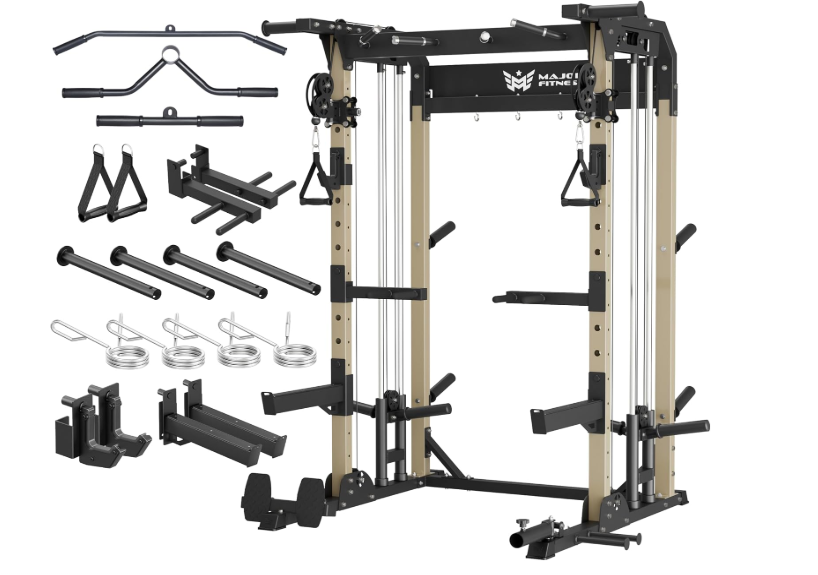
Executive Summary
Buy the Major Fitness F22 if you want one garage-gym centerpiece for barbell lifts, cable work, pull-ups, dips, rows, and landmine exercises—and you have a permanent space roughly five feet by five-and-a-half feet with enough ceiling clearance. Skip it if smooth, fast selectorized cable work is your top priority, or if you need equipment that folds away after every session.
The pitch is simple: replace several machines with one rack.
The tradeoff is equally simple. The F22 is a capable plate-loaded generalist, not a commercial functional trainer. Its value comes from versatility and included attachments, while its compromises show up in assembly, plate changes, cable smoothness, hole spacing, and the amount of planning required before a 278-pound rack arrives.
Major Fitness F22 at a Glance
| Buyer question | Quick answer |
|---|---|
| Is the Major Fitness F22 worth it? | Yes for mixed barbell and cable training; less so for cable-focused bodybuilding. |
| Typical base price | About $930 before bench, barbell, plates, or package upgrades. |
| Rack dimensions | Approximately 64.2 × 58.2 × 82.5 inches. |
| Pulley ratio | 2:1, so handle resistance is roughly half the plates loaded, before friction. |
| Best for | A first serious garage gym combining compound lifts and accessory work. |
| Main drawback | Plate-loaded cable changes and a less refined pulley feel than selectorized trainers. |
BEST FOR
The ideal buyer is building a first serious garage or basement gym and wants broad exercise coverage without buying a separate rack, cable crossover, pull-up station, dip station, and landmine setup.
- + Intermediate lifters who combine barbell and cable training
- + Buyers who value included attachments and one-order convenience
- + Garage gyms with a permanent, measured equipment zone
- + Households that want 80-plus exercise possibilities in one frame
Skip If
The F22 can become an expensive obstacle if the room, training style, or ownership expectations are wrong.
- You need the rack to fold against a wall or share a parking space daily.
- You mainly train with cables and expect the glide of a dedicated selectorized functional trainer.
- Your ceiling is close to the rack's 82.5-inch height or too low for comfortable pull-ups.
- You dislike loading plates onto two pulley sides or changing setups between exercises.
- You want commercial-grade attachment compatibility with tighter one- or two-inch hole spacing.
Price Reality Check
The standard F22 is typically positioned around $930 before package upgrades. That places it above entry-level Amazon cages but below premium rack-plus-selectorized-cable systems from REP, Force USA, and similar brands.
At this price, compare the complete gym—not just the rack.
The base machine still requires a barbell, bench, and plates for most strength programs. Bundles can push the total toward $1,400 to $2,300 depending on included weights. Convenience is real, but experienced buyers may save money—or improve quality—by sourcing the bench, bar, and plates separately.
Deep Dive
Four Training Systems in One Footprint
The F22 combines a power rack, dual adjustable pulley system, multi-grip pull-up bar, and 360-degree landmine. In buyer terms, that means heavy compound lifts and lighter accessory work can happen without walking between separate machines.
The buyer benefit is exercise coverage, not luxury feel.
- Barbell squats, presses, rack pulls, and bench work use the included J-hooks and safety arms.
- Two independent pulleys support unilateral moves, flyes, rows, curls, and pressdowns.
- The low-row footplate, landmine, pull-up bar, dip handles, and included cable handles broaden the program immediately.
- The 2:1 pulley ratio makes cable movement longer and lighter than the plates loaded onto each side.
Buyer takeaway: This is strongest as a first all-purpose gym. A specialist who already owns a premium rack may prefer a dedicated cable machine instead.
Capacity Claims Versus Everyday Training
Major Fitness lists substantial capacities for the J-hooks, safety arms, pull-up bar, and cable system. Those numbers are reassuring, but most buyers will notice stability, spacing, and ergonomics long before reaching the maximum load.
- The rack weighs about 277.8 pounds and uses a broad triangular base for stability.
- Its 64.2-by-58.2-inch footprint is compact compared with multiple machines, but large compared with a basic squat stand.
- The standard rack uses relatively wide spacing between upright and pulley adjustment positions.
- Independent testing found it stable under meaningful loads, while noting that nothing about the finish feels truly premium.
Buyer takeaway: Buy for the exercises you can perform safely—not because a four-digit capacity number looks impressive.
How the Major Fitness F22 2:1 Pulley Ratio Works
The dual pulley system is the feature that separates the F22 from a normal power cage. It is also where expectations need the most calibration.
With a 2:1 pulley ratio, every two pounds loaded produces roughly one pound of resistance at the handle before friction. The tradeoff is longer cable travel and smoother movement, but effective resistance is lower than the number of plates suggests.
| Plates loaded | Approximate handle resistance |
|---|---|
| 50 lb | 25 lb |
| 100 lb | 50 lb |
| 200 lb | 100 lb |
| 300 lb | 150 lb |
The plate-loaded design keeps cost down, but changing resistance requires moving plates. Independent reviewers also report that the stock cable feel is useful rather than luxurious compared with higher-end selectorized functional trainers.
Buyer takeaway: The 2:1 ratio suits controlled accessory work, but cable-dominant lifters should calculate the effective resistance they need before buying.
Real-World Ownership Check
A rack this size is closer to installing furniture than unboxing fitness gear. Delivery, assembly, ceiling height, floor protection, plate storage, and exercise clearance are part of the purchase.
- Setup: Expect multiple boxes, many bolts, at least two capable adults, and several hours of organized assembly.
- Space: Measure the rack, pull-up headroom, barbell width, bench travel, cable paths, and plate-loading access—not only the listed footprint.
- Maintenance: Periodically check bolts, cables, pulleys, carabiners, and wear surfaces. Keep the cable path clean and correctly tensioned.
- Workflow: Plate-loaded cables add setup time when moving between heavy and light exercises.
- Deal breaker: If the rack blocks a vehicle, door, HVAC unit, or storage area, its versatility will not make the room frustration disappear.
Common Major Fitness F22 Complaints
The recurring concerns are not that the F22 cannot function as a home gym. They are mostly about where its value-focused design becomes noticeable during ownership.
- Pulley feel: Owners and reviewers sometimes describe the stock plastic-pulley system as less smooth than premium aluminum or selectorized systems.
- Effective cable resistance: The 2:1 ratio means buyers need twice the loaded plate weight to reach a given handle resistance.
- Adjustment spacing: Wider hole and pulley-position spacing can make ideal bar or cable positioning harder for some exercises.
- J-cup wear: Aggressive barbell knurling can wear protective contact material over time.
- Height and fit: Taller users may find the 82.5-inch frame compact for pull-ups, while low-ceiling buyers may have almost no headroom.
- Assembly burden: Multiple boxes, hardware sorting, cable routing, and final alignment make this a several-hour project rather than a quick setup.
Buyer takeaway: These are manageable compromises for a value-focused all-in-one rack, but they become frustrating when the buyer expects commercial-gym refinement.
How Much Room Does the Major Fitness F22 Really Need?
The published 64.2-by-58.2-inch footprint is only the metal frame. A usable gym zone also needs room for the barbell, plate loading, bench movement, cable travel, pull-ups, and safe entry around the rack.
- Frame: About 64.2 inches deep, 58.2 inches wide, and 82.5 inches tall.
- Ceiling: A ceiling around 90 to 96 inches gives more practical pull-up headroom; this is planning guidance, not a manufacturer requirement.
- Barbell width: Plan for a seven-foot Olympic bar plus hand and plate-loading clearance on both ends.
- Front clearance: Leave room for a bench to move in and out and for cable exercises performed outside the rack.
- Rear and side clearance: Confirm that you can load plates, access storage pegs, and inspect the pulley path without squeezing against a wall.
A five-by-five-foot rack can easily require a training zone closer to ten-by-eight feet.
Before ordering, mark the complete working area with painter's tape and move through a squat, bench setup, row, cable fly, and pull-up approach. That simple test is more useful than relying on the product footprint alone.
Major Fitness F22 vs. F22 Pro
The base F22 and F22 Pro solve the same basic problem, but they target different budgets and training habits. The standard F22 emphasizes value and broad exercise coverage. The F22 Pro asks you to pay more for a more refined cable workflow, sturdier construction, and fewer interruptions between exercises.
| Decision point | F22 | F22 Pro |
|---|---|---|
| Best reason to buy | Maximum versatility near the $1,000 tier | Faster, more convenient cable training |
| Cable workflow | Plate loaded; resistance changes require moving plates | Selectorized stacks reduce setup time |
| Adjustment feel | Functional but budget-oriented | More refined for frequent cable changes |
| Best buyer | Mixed barbell/cable lifter watching total cost | Cable-heavy lifter willing to pay for convenience |
| Value verdict | Better raw value | Better ownership experience when used frequently |
Buyer takeaway: Choose the standard F22 when price and exercise coverage lead the decision. Choose the F22 Pro when cable convenience is central enough to justify the much higher total cost.
What I Would Compare Next
Compare by space, cable workflow, and upgrade path—not by the number of exercises printed in the marketing.
- Major Fitness Drone models: Compare if Amazon pricing is substantially lower and you can accept lighter-duty compromises.
- Major Fitness F35: Compare if reclaiming floor space matters more than the deeper four-post structure.
- Major Fitness F22 Pro: Compare if selectorized stacks, tighter adjustments, and heavier construction justify roughly double the price.
- Force USA G3: Compare if a Smith machine and a more established premium all-in-one platform matter.
- REP rack plus functional-trainer system: Compare if long-term modularity, attachment compatibility, and cable refinement matter more than initial cost.
Buyer Signal Analysis
The F22 attracts buyers because its value is easy to understand and difficult to verify from specifications alone. A single frame appears to solve the entire home-gym problem, but the real decision depends on room geometry, cable expectations, attachment preferences, assembly tolerance, and which equipment the buyer already owns.
Buyer Confidence by Evidence Type
Assimilated Signal Sources
- ManufacturerMajor Fitness lists the rack at $929.99 with a 64.2-by-58.2-by-82.5-inch frame, dual 2:1 pulleys, included attachments, and substantial static-load claims.
- Professional reviewsGarage-gym reviewers generally praise stability, versatility, and included hardware while noting budget-tier finish, wide adjustment spacing, and variable cable feel.
- YouTube demosVideo reviews are particularly useful for seeing cable travel, plate changes, assembly scale, pull-up clearance, and how much floor space surrounds the rack during exercise.
- Amazon ownersAmazon-linked review tracking reports roughly 264 ratings near a 4.6-star average, suggesting meaningful adoption but not eliminating delivery and assembly risk.
- Community chatterHome-gym discussions tend to focus on Major Fitness versus REP, Force USA, and cheaper Amazon racks, plus questions about cable upgrades and attachment compatibility.
Unanswered Buyer Questions
QuietTrends read: The evidence is strong enough to confirm that the F22 is a capable, stable all-purpose rack. Confidence falls when the buyer expects premium cable performance, universal attachments, or effortless ownership. Measure the room, price the complete setup, and compare the cable workflow before ordering.
OUR VERDICT
Compare First
Major Fitness F22 Power Rack
The F22 is a persuasive first serious home gym for buyers who want broad versatility at a sub-premium price, but it is not the automatic choice for cable-focused training or space-constrained garages.
Final Buyer Guidance: Buy it after confirming the full exercise footprint and accepting plate-loaded cable changes. Compare the F35 if space is tight, the F22 Pro if cable convenience matters, and modular premium systems if this is intended to be a decade-long gym platform.