Executive Summary
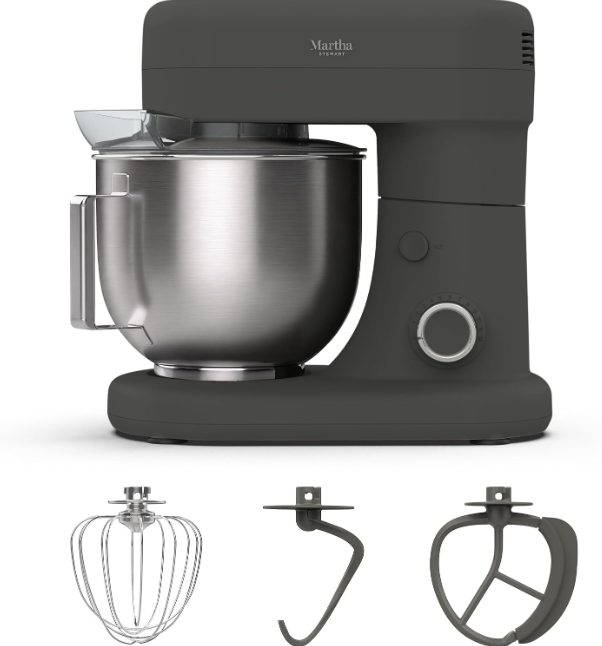
Buy the Martha Stewart 5.3Qt Stand Mixer if you are a casual or moderate home baker who wants a full-size bowl, 12 speeds, and a scraper-style beater without paying KitchenAid money. Skip it if you knead heavy bread dough every week or want a decades-proven attachment ecosystem.
The pitch is simple: premium-looking everyday baking at a budget-to-midrange price.
Early professional testing is encouraging, and current Amazon demand is real. The uncertainty is long-term durability. This mixer launched in spring 2026, so there is not yet enough owner history to treat it as a lifetime appliance.
BEST FOR
This fits the home baker who makes cookies, cakes, whipped cream, frosting, and occasional bread—and cares about appearance, easy cleanup, and not wrestling a 22-pound machine out of a cabinet.
- + Casual bakers upgrading from a hand mixer
- + Kitchens where lighter weight matters
- + Buyers who value a silicone-edge beater
- + Shoppers targeting roughly $105–$150
Skip If
The attractive price does not erase the fact that this is a young product with limited long-term evidence.
- You regularly knead dense dough or run several batches back-to-back.
- You want a broad, mature ecosystem of pasta rollers, grinders, and other powered attachments.
- You prefer an all-metal, repairable machine with decades of parts availability.
Price Reality Check
The regular price is about $149.99, with recent promotions near $105. That puts it well below the typical KitchenAid Artisan while offering a 5.3-quart bowl, 12 speeds, splash guard, whisk, dough hook, and silicone-edge flat beater.
At $105, this is a compelling casual-baker buy. At $150, compare more carefully.
The value is strongest when the included accessories and easier bowl scraping save you from buying extras. The price advantage matters less if you expect professional-duty dough performance or plan to build an attachment collection.
Deep Dive
Capacity and everyday mixing
The 5.3-quart stainless bowl is large enough for normal family baking without pushing the machine into commercial territory. Independent testing found it particularly well suited to whipped cream, cookies, cakes, and other casual-baking jobs.
This is a weeknight-and-weekend mixer, not a bakery production tool.
- Twelve speeds provide more gradual control than many budget mixers.
- The tilt head makes ingredient additions and bowl access straightforward.
- The silicone-edge beater reduces stop-and-scrape interruptions.
Buyer takeaway: Its strongest case is convenience across common recipes, not brute-force kneading.
Power claims versus real workload
The Amazon listing specifies a 660-watt motor, but wattage alone does not predict torque, gearing, heat management, or lifespan. Early tests suggest capable everyday performance, while owner feedback still lacks the multi-year depth needed to judge heavy dough durability.
The number sounds impressive. The long-term evidence is still catching up.
- Use lower speeds for dough and follow the manufacturer’s batch guidance.
- Listen for strain, head movement, or overheating during thick mixtures.
- Do not assume higher wattage automatically beats a heavier geared mixer.
Buyer takeaway: Treat 660 watts as a specification, not a durability guarantee.
Real-World Ownership Check
The lighter body makes this easier to move than many traditional stand mixers, but that convenience comes with more plastic in the housing and controls. Suction feet help stabilize it, and the dishwasher-safe accessories simplify cleanup.
- Setup: Lock in the bowl, choose an attachment, fit the splash guard, and start low to control flour.
- Maintenance: Dishwasher-safe accessories help, but the motor body and attachment hub still need careful wiping.
- Fit: Check the roughly 16.9-inch depth and tilt-head clearance under upper cabinets.
- Deal breaker: Limited long-term parts and durability evidence compared with established mixer platforms.
What I Would Compare Next
The buyer question is not simply “Is it good?” It is “Which compromise fits how often I bake?”
- KitchenAid Artisan 5-Quart: Compare build, attachment ecosystem, resale value, and long-term serviceability.
- Cuisinart 5.5-Quart SM-50: Compare sale pricing, metal construction, bowl capacity, and warranty.
- A quality hand mixer: A better route for small kitchens and people who bake only a few times per year.
Buyer Signal Analysis
This mixer is generating attention because it lands in a useful gap: it looks more considered than many budget mixers, costs far less than the category icon, and includes practical accessories. What buyers still lack is a deep, consistent body of long-term testing.
Assimilated Signal Sources
- ManufacturerThe listing claims a 5.3-quart bowl, 12 speeds, 660 watts, dishwasher-safe tools, and a silicone-edge beater.
- Professional reviewsEarly comparative testing favors it for casual bakers and everyday recipes, while stopping short of positioning it as a heavy-duty replacement.
- YouTube demosVideo coverage is still developing; useful demonstrations should focus on head movement, dough strain, bowl coverage, and noise.
- Amazon ownersThe Caviar Gray listing shows a developing owner base, with praise for value and usability but too little age to establish lifespan.
- Reddit chatterDiscussion is sparse and mostly comparison-driven, especially around KitchenAid longevity, construction, and attachment compatibility.
Unanswered Buyer Questions
QuietTrends read: The current evidence supports a value-first recommendation for casual baking, with a compare-first warning for frequent dough work and buyers who expect a ten-year machine.
OUR VERDICT
COMPARE FIRST
Martha Stewart 5.3Qt Stand Mixer
A strong-value, attractive everyday mixer with useful accessories, tempered by a short durability record and limited attachment ecosystem.
Final Buyer Guidance: Buy near $105 if you mainly make cakes, cookies, cream, and occasional dough. Near $150, compare the Cuisinart SM-50 and sale-priced KitchenAid models before deciding.