Executive Summary
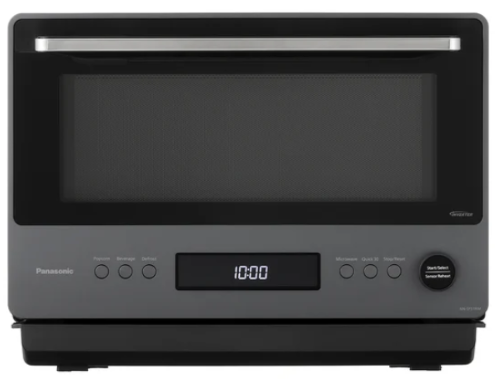
Buy the Panasonic NN-SF57RM if you frequently reheat leftovers, hate guessing cook times, and value a compact appliance that does ordinary microwave jobs unusually well. Skip it if you want air frying, convection cooking, a large family-size cavity, or the cheapest dependable microwave.
The pitch is simple: press one button and trust it to stop.
Its infrared Genius 2.0 sensor scans food temperatures across multiple points while a moving antenna directs microwave energy through a flat, turntable-free cavity. Early hands-on testing is unusually positive, but this is still a new $430 microwave with thin long-term owner data and a few important limits around covered food, layered bowls, edge heating, and warranty length.
BEST FOR
This is best for someone who uses a microwave constantly but does not want a giant countertop combination oven. It is a premium convenience buy for leftovers, beverages, defrosting, popcorn, butter, and chocolate—not a replacement for a full oven.
- + Busy households that reheat plated leftovers several times a day
- + Small kitchens that benefit from a flat one-cubic-foot cavity
- + Buyers who regularly undercook, overcook, or hover over microwave food
- + People who prefer physical controls and no app or Wi-Fi dependence
Skip If
- You mainly want an air fryer, toaster oven, convection oven, or all-in-one appliance.
- You routinely cook large casseroles or need more than one cubic foot of interior space.
- You cover every dish while reheating and do not want to change that habit.
- You need consistently even results at the extreme edges of the cooking chamber.
- You are satisfied with a $150-to-$250 inverter microwave and do not mind entering time manually.
Price Reality Check
At roughly $430, the NN-SF57RM is a premium countertop microwave. It costs substantially more than a capable basic Panasonic or Toshiba model, while competing with multifunction microwave-air-fryer combinations that appear to do more.
You are paying for better judgment, not more cooking modes.
The value makes sense only if reliable sensor reheating is a daily benefit. A household that reheats food ten times a week may appreciate the reduced guesswork. A household that uses a microwave mainly for popcorn and occasional beverages probably will not.
Deep Dive
Genius 2.0 Temperature Sensing
Most sensor microwaves infer doneness from steam. Panasonic instead uses an infrared sensor that scans surface temperature at 64 points and checks repeatedly during cooking.
The practical benefit: fewer rubbery leftovers and fewer repeated 30-second cycles.
- Single-layer plated food is the strongest use case because the sensor can see the food surface.
- Layered bowls can still heat unevenly because cooler ingredients may be hidden underneath warmer food.
- Covered dishes interfere with infrared sensing, so sensor mode changes normal splatter-control habits.
- Early testing found strong results for leftovers, beverages, defrosting, butter, and popcorn.
Buyer takeaway: The sensor appears genuinely useful, but it works best when the food is exposed and spread reasonably evenly.
No Turntable, More Usable Space
A moving antenna under the chamber distributes energy, allowing Panasonic to remove the rotating glass tray. That makes the one-cubic-foot interior feel larger than its specification suggests and simplifies cleaning.
Buyer takeaway: The flat cavity is a meaningful benefit for rectangular plates and cleanup, though testing still found cooler areas near the door and side edges.
Simple Controls, Questionable Recipe Modes
The core sensor-reheat dial is intentionally simple. Dedicated beverage, popcorn, defrost, power, and timed-cook controls cover normal use. The eleven programmed scratch-cooking recipes are less persuasive.
Buyer takeaway: Buy it for reheating intelligence. Treat the built-in recipes as a bonus you may never use.
Real-World Ownership Check
The microwave measures about 18.5 inches wide, 15.3 inches deep, and 13.7 inches high, weighs roughly 27 pounds, and uses a pull-down door. It is compact for its usable cavity, but buyers should measure door clearance as well as cabinet depth.
- Setup: No app, account, or network is required. Place it with appropriate ventilation and learn which foods work best in sensor mode.
- Cleaning: The flat floor eliminates the glass turntable and roller ring, making spills easier to wipe.
- Workflow: Sensor cooking works best with uncovered, visible food, which may increase splatter risk.
- Warranty: Coverage is one year for parts and labor, with five years on the magnetron.
- Deal breaker: If you need one appliance to microwave, toast, roast, and air fry, this deliberately focused machine will feel overpriced.
What I Would Compare Next
- Breville Smooth Wave: Compare for premium inverter reheating, soft-close design, and established owner history.
- Panasonic HomeChef 4-in-1: Compare if convection and air frying matter more than one-button simplicity.
- Toshiba 7-in-1 inverter models: Compare for lower price and more modes, accepting a busier interface.
- Standard Panasonic inverter microwaves: Compare if you mainly want even power delivery without paying for the new infrared system.
- Ninja CRISPi Microwave: Watch if roasting and air-frying flexibility are more appealing than sensor-focused reheating.
Buyer Signal Analysis
This product deserves attention because it improves a boring, frequent task instead of stacking on trendy connectivity. The evidence for sensor reheating is strong in one detailed hands-on review, but exact-model owner history remains limited because the microwave is new to the US market.
Buyer Confidence by Evidence Type
Assimilated Signal Sources
- ManufacturerPanasonic specifies a 1.0-cubic-foot cavity, 1,200 watts, Genius 2.0 infrared sensing, inverter control, and a moving antenna instead of a turntable.
- Professional reviewsWIRED awarded it 9/10 after testing leftovers, defrosting, popcorn, beverages, butter, recipes, and heat distribution.
- YouTube demosVideo is most useful for showing the pull-down door, sensor progress display, flat cavity, and countertop footprint.
- Amazon ownersExact-model review volume is still young; durability, display behavior, door feel, and service experiences need time.
- Buyer discussionThe central comparison is a focused premium microwave versus a cheaper inverter model or a multifunction microwave-air-fryer oven.
Unanswered Buyer Questions
QuietTrends read: The technology appears more useful than gimmicky. The uncertainty is not whether it works—it is whether your microwave habits justify paying a premium for it.
OUR VERDICT
Compare First
Panasonic NN-SF57RM Japanese Microwave
A genuinely smarter microwave for frequent reheaters, but the $430 price demands an honest comparison with cheaper inverter models and multifunction ovens.
Final Buyer Guidance: Buy it if reheating accuracy, simplicity, and a flat compact cavity matter every day. Compare first if you want air frying, need larger capacity, cover most food, or use your microwave only occasionally.