Executive Summary
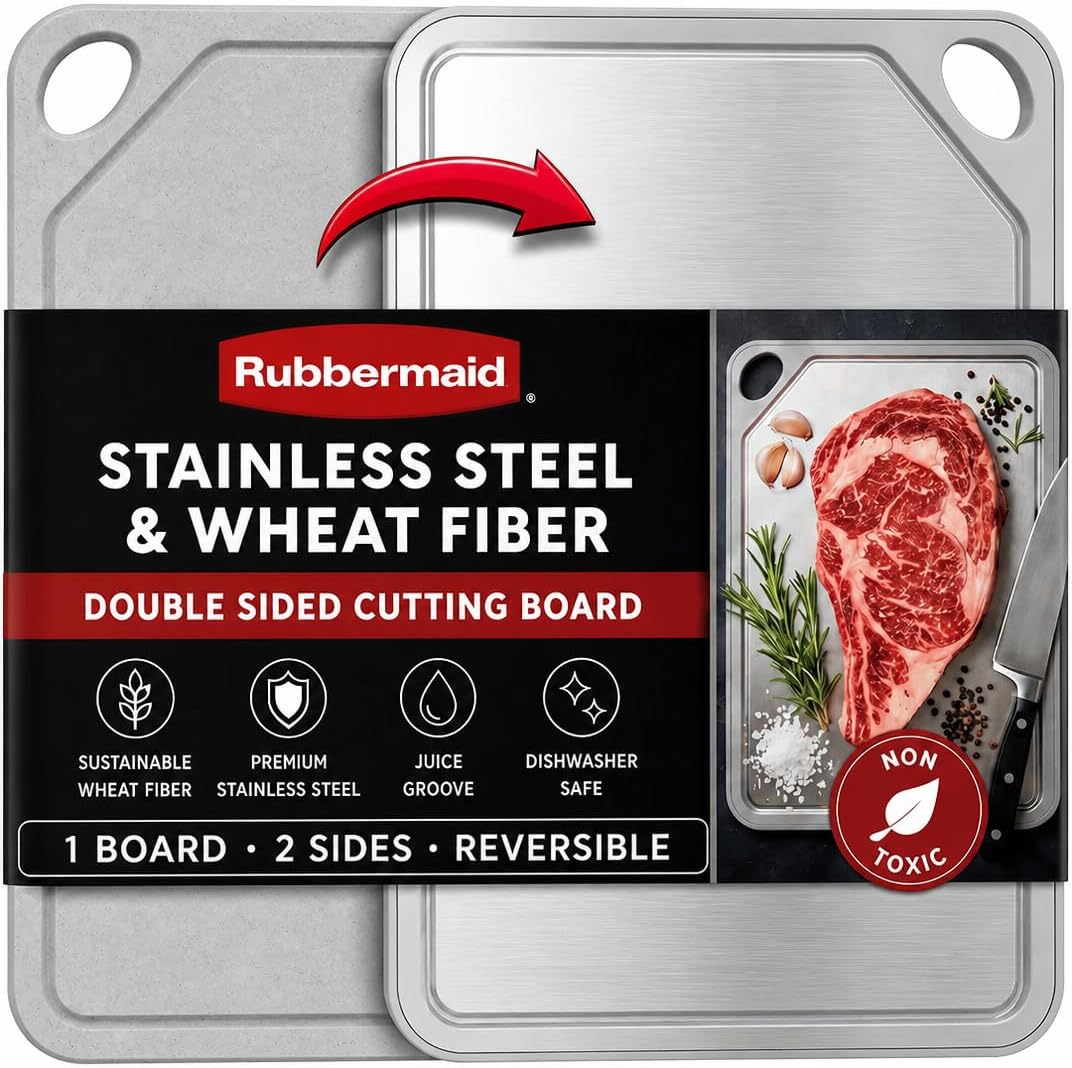
Buy it for the two-sided workflow, not because stainless steel is magically better for knives. Rubbermaid's new board pairs a rust-resistant stainless-steel face with a wheat-fiber face that is intended to be gentler on knife edges. That makes it more sensible than an all-metal board for a household that wants a nonporous protein-prep surface without giving up a softer everyday chopping side.
The useful idea is separation: steel for messy prep, wheat fiber for knife work.
The catch is important. Knife enthusiasts broadly warn that hard metal cutting surfaces can accelerate edge wear. Rubbermaid's own positioning effectively acknowledges that tradeoff by giving you the second, gentler surface. If you plan to chop everything directly on the steel side, a quality wood or conventional synthetic board is the safer choice for your knives.
BEST FOR
This board makes the most sense for cooks who want one dishwasher-safe board with clearly different jobs on each face. It is especially appealing if raw-meat cleanup bothers you but you still want a more knife-friendly surface for vegetables and routine chopping.
- + Cooks who want a nonporous steel surface for raw proteins
- + Households that prefer dishwasher-safe prep tools
- + Small kitchens where one reversible board can replace two boards
- + Buyers curious about metal boards but unwilling to use steel for every cut
Skip If
The steel side is the reason this product is interesting, but it is also the reason some buyers should pass.
- You use expensive, finely sharpened kitchen knives and want the most edge-friendly cutting surface possible.
- You want a large carving board; at roughly 14 by 10 inches, this is a practical everyday size rather than an oversized holiday-roast platform.
- You dislike the sound or feel of a knife contacting metal.
- You already use separate HDPE and wood boards and are happy with that workflow.
Price Reality Check
The board has recently sold around $20, with a list price around $30. That is inexpensive enough to experiment with the format without paying the premium attached to many titanium or boutique composite boards.
Around $20, the value case is convenience—not exotic material science.
The strongest reason to pay for it is the combination of a recognized kitchen brand, two purpose-built surfaces, juice grooves, and dishwasher-safe cleanup. If it returns to $30, compare it more carefully with a good commercial-style synthetic board or an edge-grain wood board.
Product Deep Dive
The Double-Sided Design Is the Real Feature
Rubbermaid describes one side as rust-resistant stainless steel for raw meat or bread and the other as wheat fiber for fruits, vegetables, and general chopping. That division is more thoughtful than marketing an all-steel slab as an all-purpose replacement.
Use the hard side selectively and the design starts to make sense.
- The steel face is nonporous and resists stains and odors.
- The wheat-fiber face gives your knife a less aggressive landing surface.
- Using separate faces for proteins and produce can make prep organization easier.
Buyer takeaway: Treat the steel side as a specialized prep surface rather than your default chopping surface.
Knife Wear Is the Question You Should Not Ignore
Community discussion around stainless-steel cutting boards is unusually consistent: many experienced cooks and knife sharpeners dislike hard cutting surfaces because repeated edge contact can dull a blade faster than wood or softer synthetic boards. That concern is about material hardness and edge impact, not whether the board is sanitary.
- Heavy chopping on steel is the highest-risk use pattern for edge retention.
- Light slicing or transferring raw protein is a different workload from repeatedly striking the board.
- The wheat-fiber side exists for the jobs where knife friendliness matters more.
Buyer takeaway: If knife sharpness is a priority, do most cutting on the wheat-fiber side.
Dishwasher Cleanup Is a Genuine Everyday Advantage
Unlike a wood board, this Rubbermaid is marketed as dishwasher-safe. That matters most after raw chicken, fish, or other messy protein prep, when a board that can go straight into the dishwasher reduces cleanup friction.
- Both sides include juice grooves to help contain liquids.
- The board is advertised as stain-, odor-, and warp-resistant.
- Its slim profile should be easier to store than a thick butcher block.
Buyer takeaway: The strongest practical argument for this board is low-maintenance cleanup.
Real-World Ownership Check
This is a simple product, so ownership comes down to surface wear, knife habits, dishwasher fit, and whether the reversible design actually matches how you cook.
- Setup: None beyond washing before first use and deciding which foods you want assigned to each side.
- Maintenance: Dishwasher-safe construction eliminates oiling and hand-drying routines associated with wood.
- Fit: At about 14 x 10 x 0.3 inches, it should fit ordinary counters and many dishwashers easily, but it is not a giant carving board.
- Wear: Expect a working steel surface to show scratches over time; cosmetic marks are different from corrosion or structural failure.
- Deal breaker: If metal-on-knife contact makes you cringe, you will probably never enjoy using half of this product.
What I Would Compare Next
The right comparison depends on why this board caught your attention.
- HDPE commercial cutting board: Compare if dishwasher-style sanitation and knife friendliness matter more than appearance.
- End-grain or edge-grain wood board: Compare if protecting sharp knife edges and tactile chopping feel are your priorities.
- SNOWCLAD double-sided stainless/wheat-straw boards: Compare if you want the same two-material concept in different sizes or sets.
Buyer Signal Analysis
Rubbermaid entered a product niche that already generates strong debate, and early demand arrived before deep editorial coverage. Amazon-market tracking showed the exact ASIN at roughly $19.99 with an early 4.3-star average from 17 ratings, while recent editorial roundups reported more than 1,000 purchases in the prior month. That is meaningful buyer activity for a newly surfaced kitchen tool, but still too little owner history to settle long-term questions.
Assimilated Signal Sources
- Manufacturer/listing claimsRubbermaid positions the board as double-sided, dishwasher-safe, BPA-free, stain- and odor-resistant, with steel for raw meat or bread and wheat fiber for produce and knife-friendly prep.
- Professional coverageFood & Wine and Allrecipes both highlighted the board among Amazon's August 2026 new kitchen arrivals. Their coverage establishes new-release momentum, but it is not a substitute for long-term hands-on testing.
- YouTube demosExact-model independent video testing remains sparse, so scratch progression, cutting sound, grip, and long-term surface wear are not yet well documented.
- Amazon ownersEarly marketplace tracking shows a positive but still small rating base. Seventeen ratings is useful directional evidence, not mature reliability data.
- Reddit chatterBroader stainless-steel cutting-board discussions repeatedly focus on knife dulling. Some owners report acceptable wear, but the dominant concern is harder surface contact versus wood or HDPE.
Unanswered Buyer Questions
QuietTrends read: The product is more sensible than the phrase “stainless-steel cutting board” initially sounds because Rubbermaid gives you a second, gentler surface. The buying decision depends on whether you will actually use the two sides differently.
OUR VERDICT
BUY WITH THE RIGHT WORKFLOW
Rubbermaid Stainless Steel Cutting Board
At roughly $20, this is a practical way to get an easy-clean steel prep surface without committing to steel for every knife task.
Final Buyer Guidance: Buy it if you want steel for raw-protein prep and a separate wheat-fiber face for chopping. Skip it if you intend to chop constantly on steel or if preserving a fine knife edge is your top priority.